
#21 GOOD GRIEF NEWS
IN BETWEEN VERSIONS: THOUGHTS ON MIDLIFE GRIEF
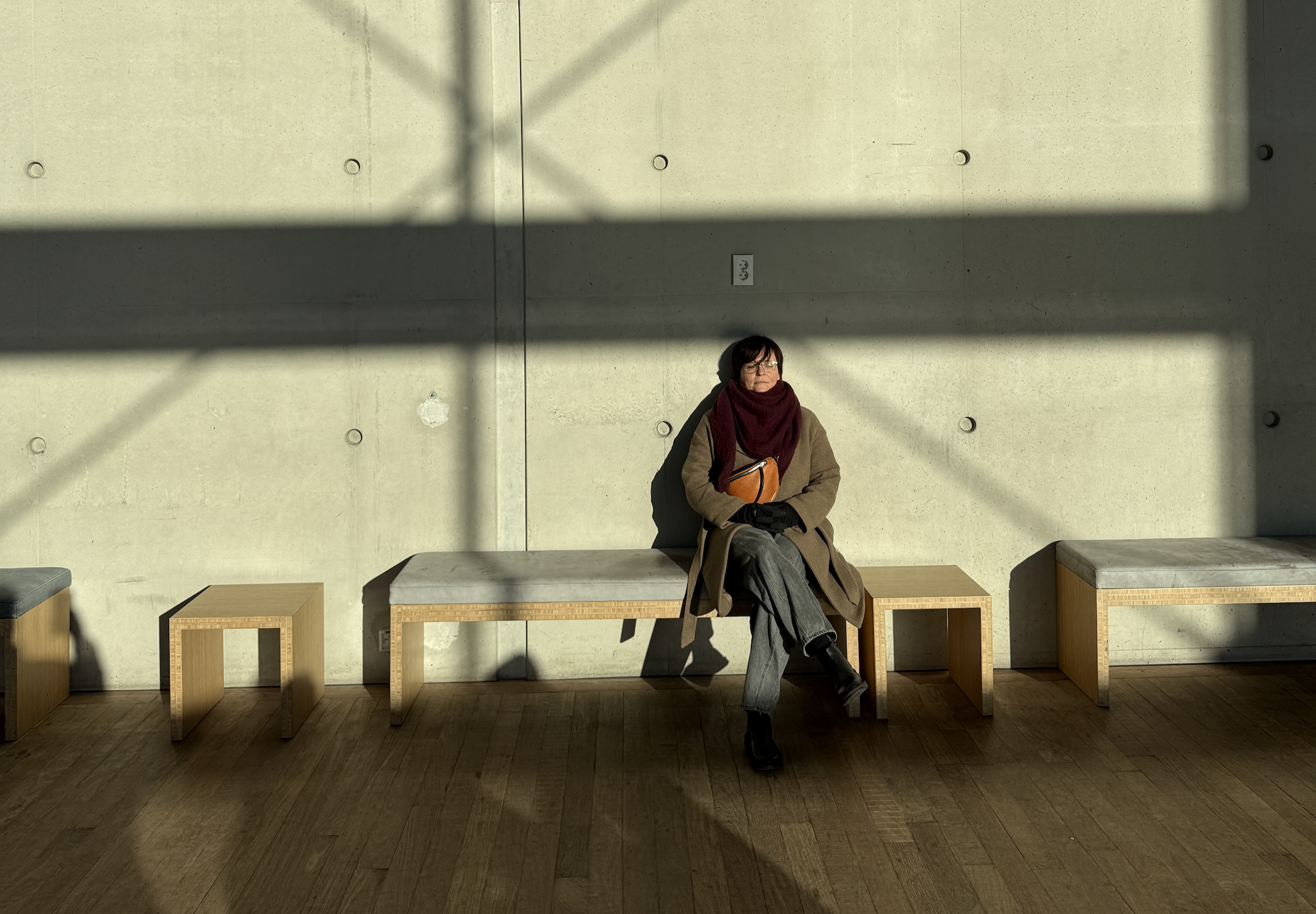
Own picture.
There are small moments lately that catch me off guard:
Taking off my glasses sometimes to read a smaller font or scrolling quite a bit to find my birth year in a dropdown menu, further down than it used to be. The day after a late night now ideally requires a full day of recovery (or two) and a level of self-forgiveness I didn't previously need.
At work, topics I thought about at the very beginning of my career are currently cycling back around (how weird). And for years, I worked hard to be taken seriously by clients much older than me. Now, I work to maintain my credibility with clients younger than me – when was actually the sweet spot where my age was exactly right?
And then there are the unexpected, sweet changes. My fourteen-year-old is now taller than me. When I realised this, we created a little ritual around it. I carried him one last time as a proper farewell to his childhood. It was a little silly but also touching.
When I talk to friends, I realise that we're all discussing similar topics at the moment: Our bodies behaving differently (is this perimenopause already?), our parents needing more care and our careers no longer feeling quite right.
And then there is the 90s song that comes on unexpectedly and sends you straight back to being fourteen and hopelessly in love. That strange feeling of almost travelling through time to meet a younger version of yourself, including all the feelings.
None of this feels dramatic or particularly bad either. But I’ve been thinking about what connects all these moments and recently discussed with a couple of friends if the answer could be: Midlife Grief. Let's explore this idea together.
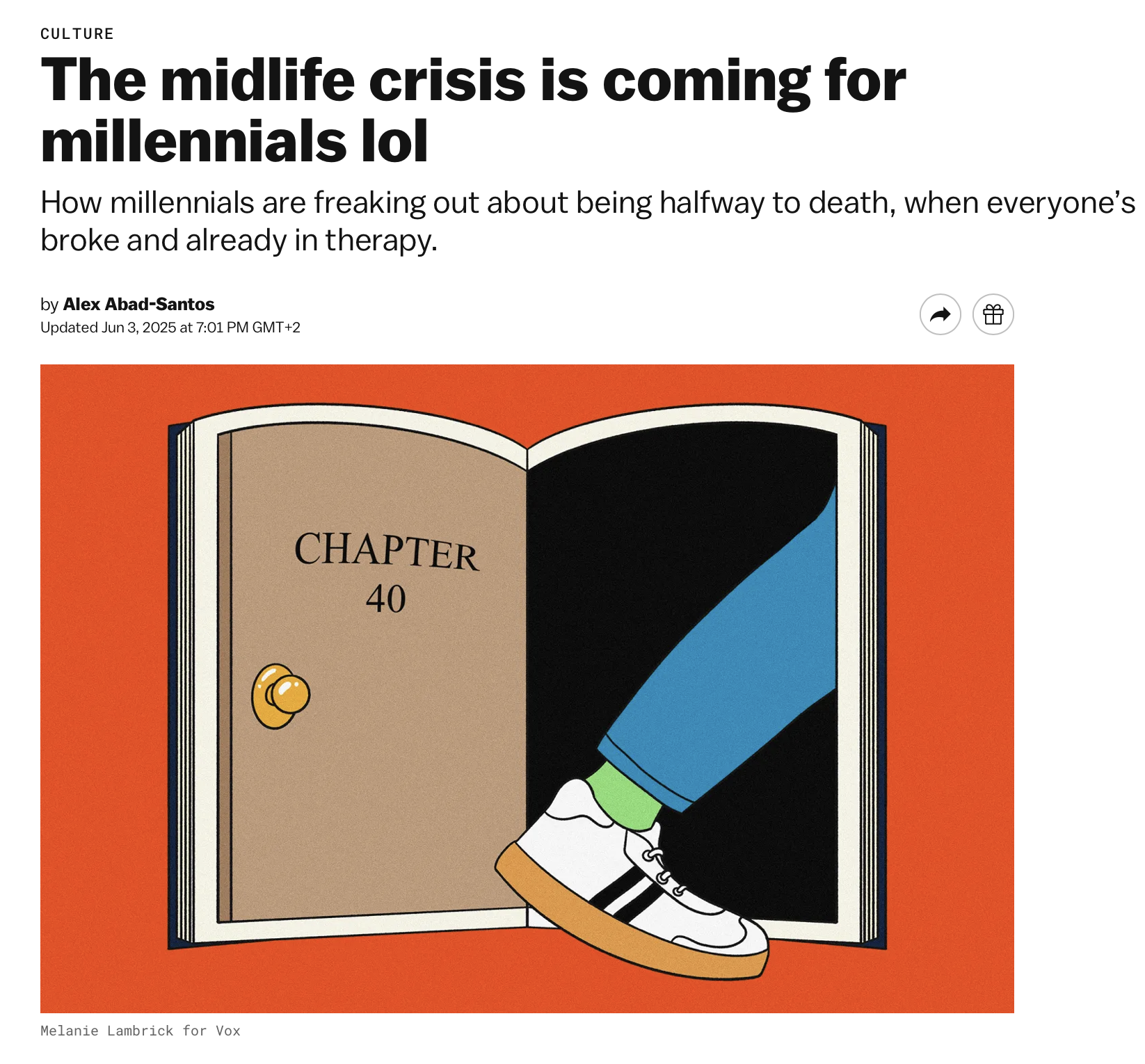
Screenshot of VOX article
Midlife grief vs. 'midlife crisis'
More familiar than 'midlife grief' is a term we all know from popular culture: the midlife crisis. The concept was coined by psychoanalyst Elliott Jaques in the 1960s, originally describing the moment when individuals confront their own mortality and reassess the trajectory of their lives. Over time this was simplified into a cliché: the sports car, the affair, the dramatic haircut. The underlying message was that somewhere along the way, we focused too much on work and forget to truly live – and now we're regretting it.
For millennials and younger Gen Xers, this framing often feels odd and not fitting. There are a few reasons why I believe that to be the case:
When is midlife, exactly?
The whole timeline has shifted. Increased life expectancy, improved healthcare, and changing lifestyle choices mean that what once felt like looking down a slope toward death from forty now feels, for many people, like being somewhere in the middle of a long and interesting second act. The direct confrontation with mortality that Jaques described hasn't disappeared, but its shape has changed considerably and got pushed out a bit.
No blueprints, no linear careers
Also, this cohort grew up with a fundamentally different relationship to financial security and life milestones. Most entered the workforce during or after the financial collapse of 2008, were hit again by the Covid recession of 2020, and are now navigating middle age in whatever we're calling the current state of the economy. Hitting traditional milestones like home ownership, financial stability, family, the whole package, has never been straightforward for this generation (also check the thoughts on nonlinear careers by futurist Jasmine Bina). Perhaps that's why, according to a 2024 study from the Thriving Center of Psychology, 81% of millennials polled said they couldn't "afford" to have a midlife crisis.
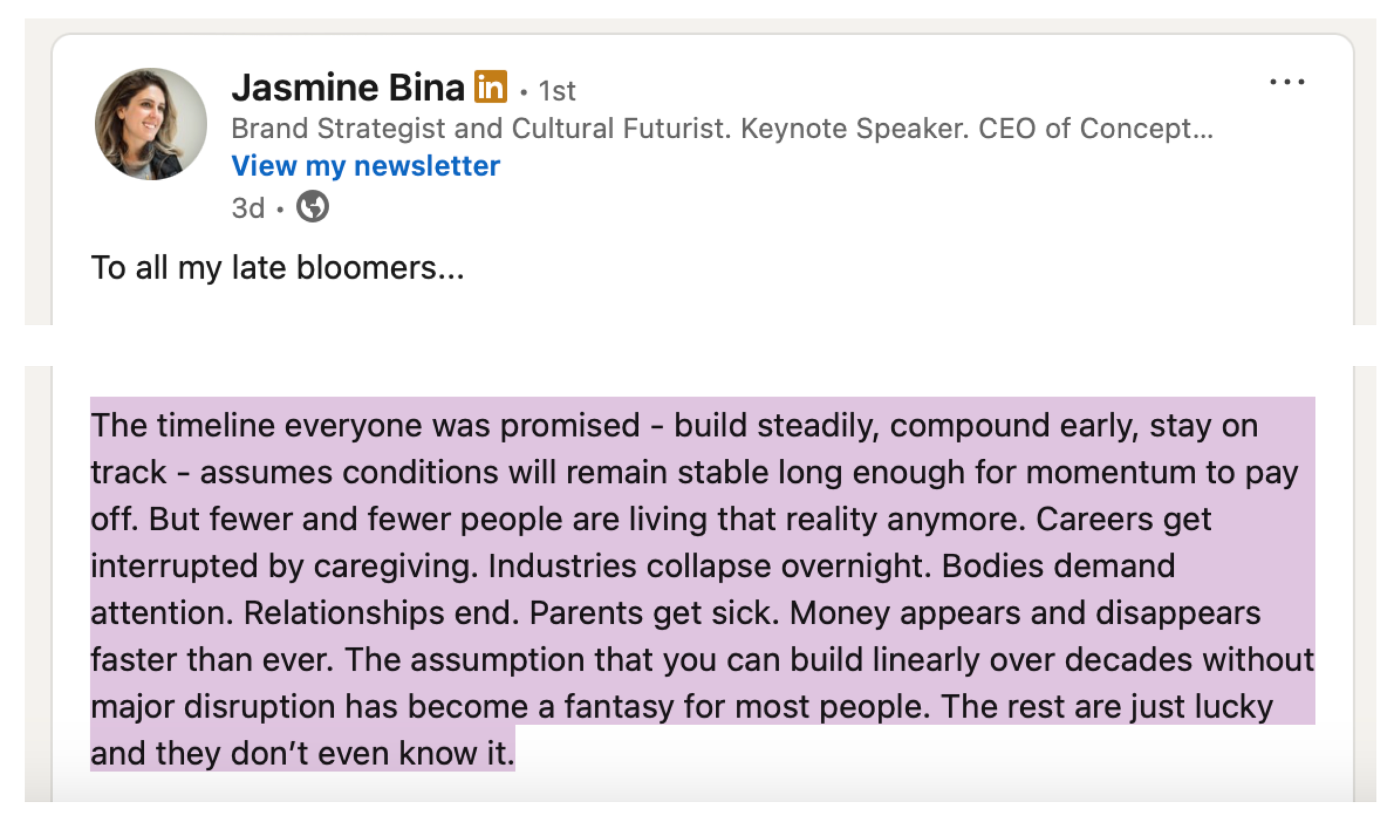
Screenshot of LinkedIn post by futurist Jasmine Bina
Millennials grew up with a heightened awareness of mental health issues, encouraged to express themselves openly and discuss relationships. They are also far more interested in experiences than possessions, and don't intend to wait until retirement to enjoy them. People took gap years, changed careers, waited to have children or didn't have them at all.
Millennial lives simply don't look like boomer or Gen X lives, and neither do their midlife reckonings. As a recent Vox piece put it: “many are looking for an opportunity rather than an escape – a fitness journey, a career change, a personal awakening that might involve tattoos – instead of something necessitating an intervention.” Midlife for this generation isn't about exploding a stable life. It's still about finding one!
Facing mortality differently
What does seem to be shifting too is our relationship to aging and death itself. Midlife crisis stereotypes were ways of exploring our fears about getting older at a safe, ironic distance. We are less scared now to take a closer look. The ‘death positive movement’, Death Cafés and discussions around alternative burial options are proof of that. When people make peace, even partially, with the fact that time is finite, you stop spending it on things that don't deserve it. You develop a finely tuned radar for nonsense.
Which might explain, incidentally, why marketers largely stop targeting women over 45. By that point, most of us have simply stopped being interested in being sold to. We are considerably harder to impress. I choose to read that as a sign of growing wisdom rather than declining relevance.
Summing up these thoughts, as one 39-year-old interviewed in the Vox piece described it, the millennial midlife experience feels less like a crisis and more like a "generational waiting room": having followed all the rules their parents gave them, school, college, job, savings, and still not arriving at the same milestones their parents reached. The defining challenge isn't despair, though. It's learning to accept that our lives simply don't look like the ones our parents had, and finding out what they actually look like on our own terms. That's not to say millennials are immune to expectations or material envy. But they might be more equipped to handle it in a healthy way than previous generations.
What’s to grieve?
So, we are not in a state of crisis, but there are still a lot of things ending, roles changing and things worth grieving (also in good ways):
Psychologist Kenneth Doka came up with the term 'disenfranchised grief'to describe situations like that. It is grief that society does not officially recognise or sanction. Nobody sends flowers when your body changes. There is no ritual for the moment you realise that the version of yourself you have been performing no longer fits. There is no acknowledgement of the gentle, ongoing loss of who you used to be.
None of these situations have a clear ending and that is exactly why they so often go unprocessed, accumulating quietly until we find ourselves sitting in a friend's kitchen, unable to quite explain why we feel off.
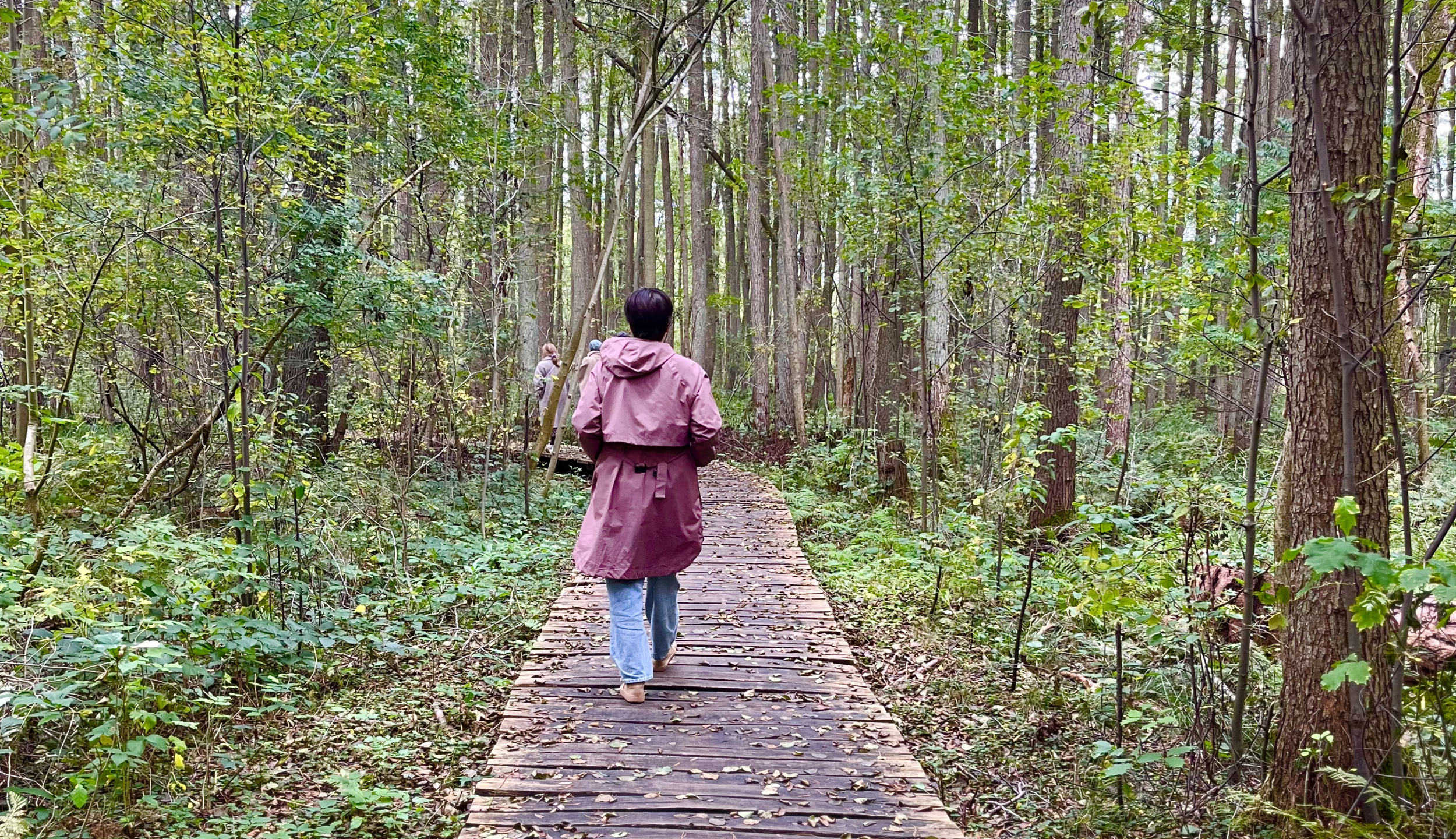
Own picture
The pressure to keep becoming
One thing I keep noticing in conversations with friends is that so much of what weighs on us isn't just the change itself. It's the relentless cultural pressure to be in a constant state of becoming. To get through school, then study, then get the job, then become a mother, then become an expert, then rebrand, then pivot. Always pushing toward the next thing. Always a project in progress.
A threshold, not a destination
Midlife is a transitional period, structurally built into adult life. Thresholds are uncomfortable precisely because you don't yet know what's on the other side. You are between versions of yourself. The old coat doesn't fit and the new one hasn't arrived.
The challenge is to stay open about what’s coming, as researcher Hollen Reischer puts it in the VOX article: “Seeing life as an open-ended tale and ongoing narrative can help make us satisfied, more realized, more mentally healthy people, especially later in adulthood — even if something feels unsure or uncertain in the moment. It’s all part of our bigger life story.”
What I find genuinely interesting, culturally, is that we seem to be at a moment where more people are refusing the available scripts for this experience, the crisis narrative and the transformation narrative alike, and are instead sitting with the uncertainty more honestly. The deeper current seems to be something like a collective refusal of performance. A growing disinterest in becoming, in favour of something harder to name: a kind of presence, or stillness, that doesn't require a product or a program.
Maybe midlife grief is not something to overcome. Maybe it’s something to move with. A slower, more reflective phase that asks for a different kind of attention. Less focused on optimisation, more on integration. Less about becoming someone else, more about understanding who we already are.
And maybe there is also something quite gentle in that.
What do you think? I'm genuinely curious where you are in all of this. Does the term midlife grief resonate with you, or does it feel like just another label for something that resists being named? Is there a loss you've been carrying quietly that this brought to the surface? A ritual you've created, like carrying your child one last time, that marked a transition you hadn't quite acknowledged? I am happy to read your thoughts. 🖤
Thanks for reading!
> Thanks for reading GOOD GRIEF NEWS, a monthly newsletter on trends and fresh perspectives around death, grief and remembrance. You can see more of my work at goodgrief.me or stefanieschillmoeller.com and feel free to follow me on Instagram.
26.04.2026