
#20 GOOD GRIEF NEWS
A SHELF, A COFFIN AND DEATH IN THE LIVING ROOM
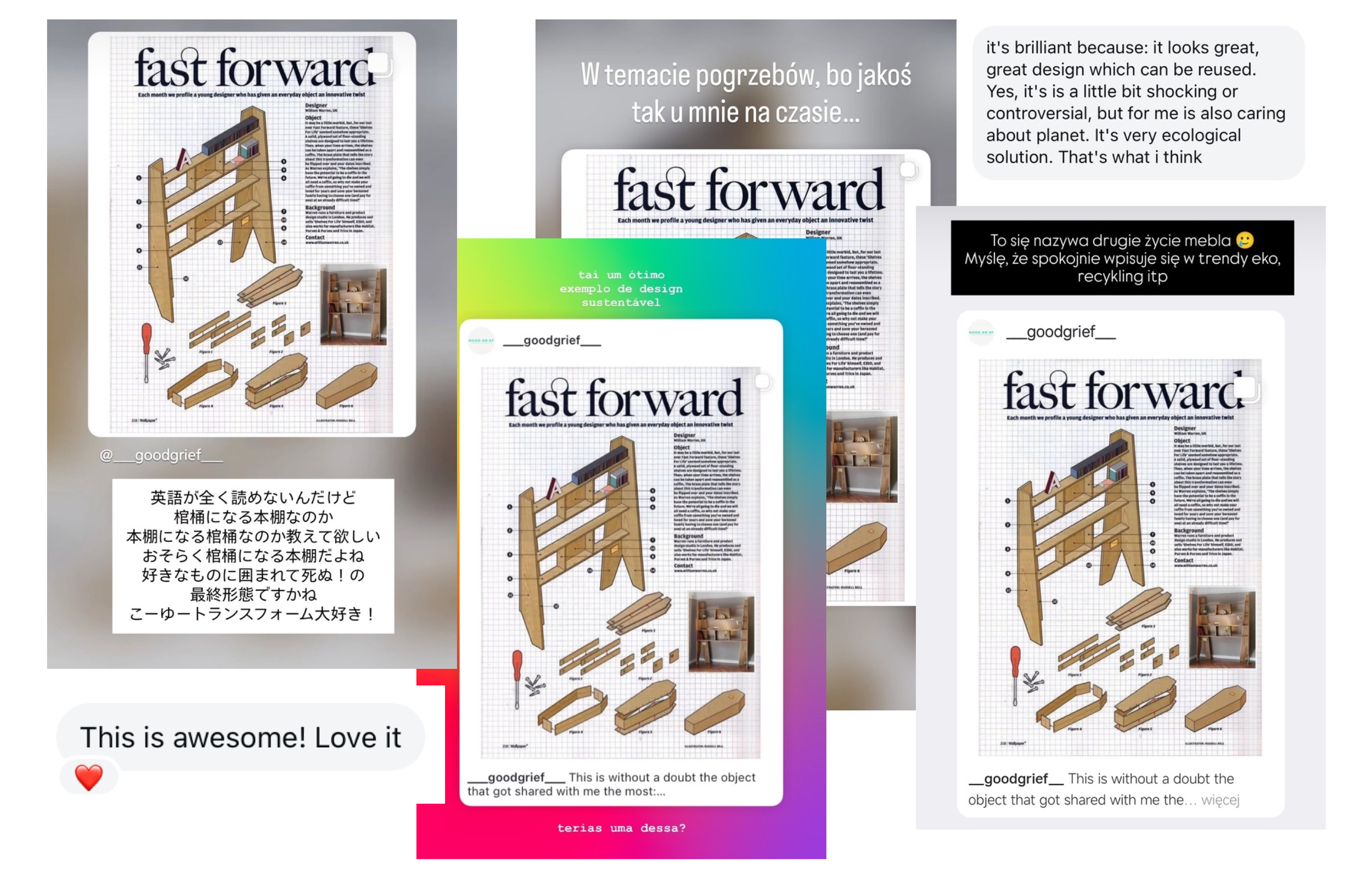
At the very end of last year, one of my Instagram posts unexpectedly took on a life of its own. It was widely shared, received lots of comments, and reached far beyond my usual audience. The response was enormous, which was quite surprising to me. I had written about a couple of observations and objects – one of them being a piece of furniture. What happened?
The object
Shelves for Life is a bookshelf designed by UK-based designer William Warren to accompany you throughout your lifetime – and then, quite literally, through your death.
Over the years, the wood of the shelf darkens, surfaces get marks, stain, and age. The shelf absorbs your routines, your traces and your stories. And when you die, it is taken apart and reassembled into a coffin. A small brass plate, hidden beneath the bottom shelf, tells this story. At the end, it is flipped over, and your dates are engraved.
First presented at the British Library during the London Design Festival 2005, Shelves for Life collapses the distance between living and dying and it basically gently asks two questions:
What if the objects we live with already knew how to accompany us at the end? What if death were designed into everyday life – not as provocation, but as continuation?
It’s about design as memento mori, furniture as a companion and death as a part of the lifecycle and not its interruption.
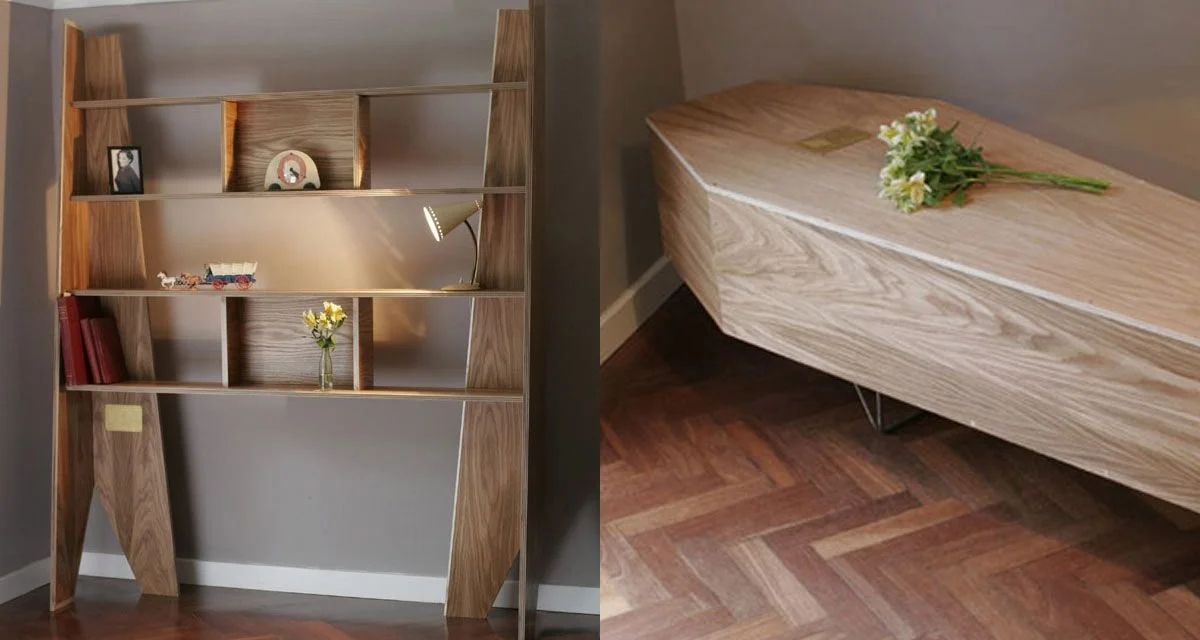
Pictures of the Shelves for Life design by William Warren
Why did this resonate so strongly?
I have been thinking about the huge number of reactions and messages I received, and I have been wondering what it was that resonated with people so strongly. What I understood: there is a real, unmet interest in new ways of thinking about remembrance, about objects, and about how we carry people (and ourselves) through time.
The responses ranged from comfort to discomfort, from irony and humor to genuine emotion. That range is telling in itself. I read all the comments and spoke directly with some followers about why this shelf had stayed with them. What emerged was less a conversation about design, and more a conversation about how we live with mortality and why we've arranged things so carefully to avoid it.
Here is my cultural reading of why Shelves for Life struck such a chord.
1. Living with it
Most of us will never see our own coffin in advance, which is a strange thing to think about. We don't choose it, touch it or live with it. The object that will eventually carry our body (and be our last home) is usually selected by others under time pressure and in an emotionally charged moment.
However, a deconstructed coffin that lives quietly as a shelf in our living room, holding books and bearing the marks of years, feels entirely different.
Again and again, people commented: "I could imagine this in my home."
Why do we keep death so spatially distant? This shelf integrates into daily life instead of announcing itself as a "death object." It belongs to the living first – and only later, gently, to the dead. In that sense, it isn't really about death at all. It's about companionship over time.
2. The hidden message (People love secrets, right?)
The shelf doesn't shout. It doesn't demand attention. Its meaning is hidden unless you know the story and there is something about that discretion that many people found deeply appealing. This fits into a broader tendency I observe again and again: a longing for objects that hold a memento mori gently, without turning grief into spectacle.
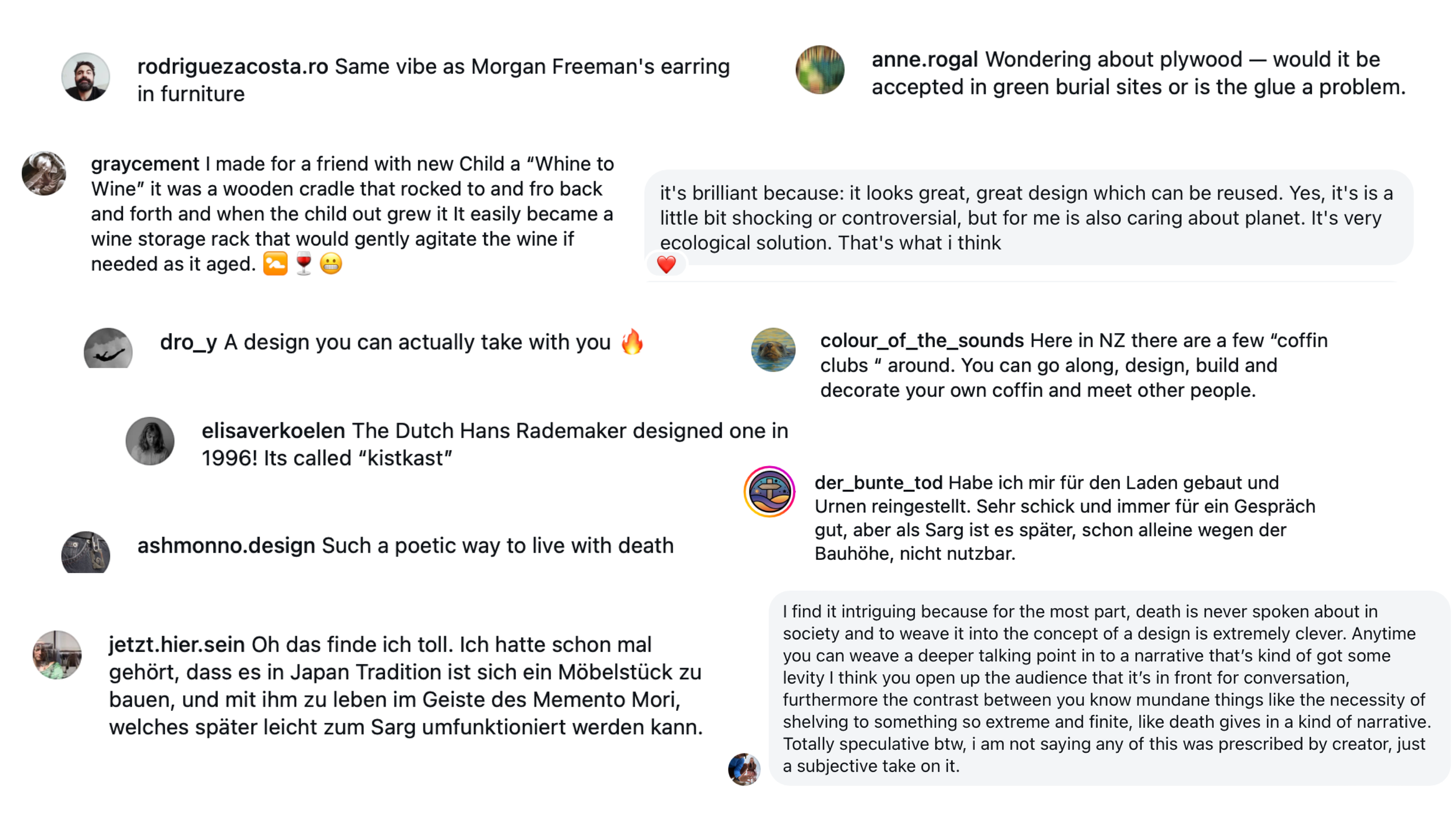
One follower put it simply: "I love practical ideas that quietly provide several solutions. I would buy this for myself." Another shared an unexpectedly touching parallel: "I once made a 'Whine to Wine' cradle — a wooden baby cradle that later became a wine rack, gently rocking the bottles as they aged."
Objects change roles as life changes around them, some more than others. And there are objects that accept time instead of resisting it.
3. The ordinary made existential
A shelf is one of the most unremarkable pieces of furniture we own. And precisely because of that, it becomes quietly powerful when it is asked to carry something as heavy as mortality. Death moves out of abstraction and into the realm of the everyday, of dust, fingerprints and the smell of wood. It is no longer monumental or symbolic, it is simply present.
The shelf feels neutral, not morbid, not spiritualized, not religious. It doesn't prescribe belief, it simply (and literally) “makes room”.
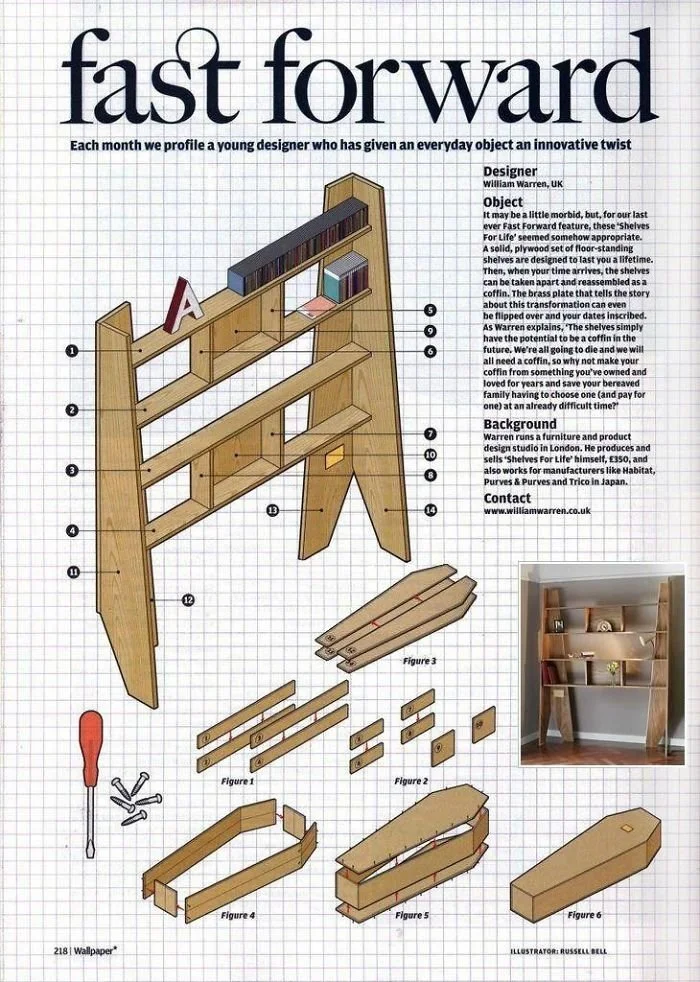
Screenshot of the Wallpaper article on the design by William Warren, taken from Reddit
4. Love from the book lovers
And then there were the book lovers. So many comments came from people who could imagine being buried alongside their books. Books are slow objects in a fast world. They require time, attention, presence, patience and in that sense, they already share something essential with death. They ask you to stop.
The sociologist Hartmut Rosa has written about how modern life accelerates us away from resonance – that feeling of being meaningfully connected to things over time. Objects like books, or a shelf that quietly ages alongside you, push back against that. They ask you to stay. One comment summed up the book lover mentality: "What a lovely thought, to be burned along with all my books."
5. Sustainability — without moralizing
There is, of course, a sustainable dimension to Shelves for Life. It takes a stand against single-use coffins and instead is serving multiple life phases. But sustainability itself barely came up as ideology in the comments. It was framed as something softer, as care — for materials, for resources, for the planet.
One follower from Ukraine added a historical layer: "Less than 100 years ago in Ukrainian villages, people weren’t allowed to cut trees in the forest, so they were forced to pick and store boards as a piece of furniture, because if someone dies they would be able to find the needed amount of boards in time." Scarcity also creates different relationships to objects.
6. Good design for everyone – even at the end
I lost count of how often IKEA was mentioned: Billy shelves, flat packs, assembly jokes, the half-serious idea that IKEA could sell coffins. But this wasn't mockery, it was imagination and perhaps something more.
IKEA defines democratic design as the right combination of form, function, quality, sustainability and low price. Good products, they say, should be there for everyone. It's a principle that has shaped how an entire generation thinks about furniture and domestic life.
So why not apply the same thinking to death? Shelves for Life is handcrafted and comes at a price that reflects that. But the idea behind it – that the objects we live and die with could be thoughtfully designed, personally meaningful, and not reserved for the privileged few – feels like a genuinely democratic impulse. Not death as luxury. Not death as clinical transaction. Death as something we hopefully have a hand in shaping.
7. Design as a door opener
Design and physical objects are among the most powerful conversation starters we have when it comes to death. People may hesitate to speak directly about burial or cremation, but they will happily discuss color, material, or form and through that, the deeper questions arrive almost naturally.
That is exactly what happened here. My DMs filled with personal stories and reflections I would never have received without this piece as a catalyst. One follower summarized it beautifully: "Weaving death into design with a bit of levity opens space for conversation."
8. The shelf as altar — and the quiet return of the sacred
One comment stated: "Orthodox Christians have been doing this for a long time." True. Many traditions have long integrated remembrance into domestic space: think of icon corners, bone shelves or home altars. All of these display objects that hold the dead close.
The historian Philippe Ariès described how death gradually moved out of everyday life over the past two centuries – from homes into hospitals and institutions. Seen through that lens, Shelves for Life doesn't feel radical so much as restorative. A small, domestic return of mortality to where it once naturally lived.
When traditional belief systems fade, the longing for meaning doesn't disappear. It finds new forms. Design becomes a ritual, furniture becomes an altar and the sacred returns quietly, through the back door.
9. Preparation without dread
The last aspect is basically about end-of-life planning. Several people described the shelf as a gentle form of preparation. "Be prepared – but in a nice way." or"This could be a retirement project."
End-of-life preparations can be quite scary, they are often linked to a lot of boring bureaucracy and are happily postponed to later lacking a sense of urgency. The shelf inspired to look at this differently and think about the “what if” case, what they would like to do, leave behind and tell their loved ones. Just the quiet satisfaction of having thought about something most people prefer not to think about at all – and finding that thinking about it didn't hurt.
10. A broader cultural shift
Traditionally, in the West, remembrance has been outsourced – to cemeteries, memorials, and institutions that manage death on our behalf. But more and more, there is a shift toward private, domestic, integrated forms of remembrance. Not moving past grief, not processing it efficiently. But living with it, gently and honestly.
So what does this tell us?
Shelves for Life sits at a rare intersection: design and death, everyday object and existential meaning, private grief without spectacle, continuity instead of rupture. The response tells me that most of us are not looking for ways to "get over" loss. We are looking for ways to live alongside it – for objects, rituals, and spaces that hold it without making it unbearable.
And to end with a smile. One follower asked: "But if I'm dead… who's going to assemble it?"
My answer was: maybe it's written into the will that fighting family members have to build it together. Or maybe strangers are invited for support. Or maybe two people meet over screws and wooden boards – and fall in love.
Who knows.
How about you? Is there an object in your home that already, quietly, holds someone's memory?
💬 Interview
When a post goes viral, you want to go straight to the source. So, I contacted the designer William Warren to ask about the object that made hundreds of strangers think about their own death.
William Warren runs a furniture and product design consultancy and teaches at several London art and design schools, including Goldsmiths and Central Saint Martins. His work, in his own words, carries a humorous conceptual twist, answering design briefs laterally, questioning utility, and improving the emotional experience of the user.
I was curious: Did he want to encourage people to think about death, or did the topic just sort of creep in?
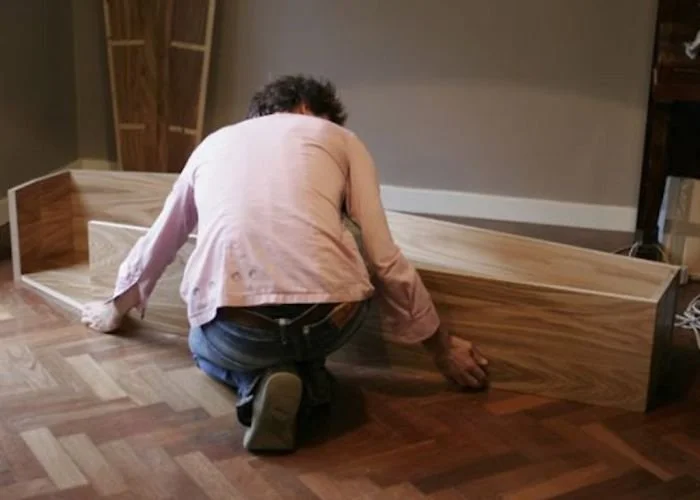
Image credit: William Warren
1. When you first imagined Shelves for Life, what observation or problem were you responding to?
The Shelves for Life grew out of me trying to design in sentimentality into new products. I think being sentimental about furniture and possessions is probably the highest value we can give to objects. Some objects we have because they are useful, some because they are beautiful and some because we love them. Today, we need to love our things more and hold onto them.
2. A shelf is one of the most ordinary pieces of furniture we own. What happens, in your view, when an everyday object is quietly asked to carry something as heavy as mortality?
Yeah, shelving is pretty mundane. Functional and easily ignored. The thing is, objects don’t need to be grand to be special. We can feel connected to people, places, events, through the most banal details. A worn grip on a handle, a stain on a tablecloth, the smell of a shed.
Mortality is indeed a heavy side order to serve with a shelf but we’re all gonna die. I have my Shelves for Life in the living room at home and it doesn’t cast the shadow of death over the room. Just a set of useful shelves with a story.
3. Many people commented on my Instagram post that they could imagine this shelf in their own home. How important was it for you that the piece integrates into daily life rather than marking itself as a “death object”?
The game for me was making a set of shelves that looked attractive and modern while being simple to convert into a coffin. I’m pleased people feel it’s ‘liveable with’.
4. People reacted with a range of emotions, from comfort to discomfort. What kind of emotional reaction did you hope to provoke—or did you deliberately leave that open?
The range of reactions has been great. Lots of my work has narratives or humour in it and I admit the shock effect is something I wanted to play with. I enjoy the gasps when people are introduced to the fact it has a second life.
5. Traditionally, remembrance is outsourced to cemeteries, memorials, or institutions. Do you see this piece as part of a wider shift toward more private, domestic forms of remembrance?
It’s a shame we have distanced ourselves so far from death in modern life. We don’t see the dead. We don’t talk about death enough. We mostly pretend it doesn’t affect us. The thing is, this just papers over a fundamental part of life and unfortunately leaves your grieving relatives to have to fall back on the terrible rubbish offered by the businesses who claim to deal with death on your behalf. I was horrified to learn about the chip-board coffins with printed wood effect faces and plastic handles that 90% of people get put in at massive inflated prices.
6. Do you think designers have a role to play in helping society become more fluent in grief and mortality?
Yes, designers can and should play more of a role in helping us with loads of deep stuff. Design became rather shallow and face value over the 20th century, particularly in recent years. Historically though, craftsmen have always used meaning embedded in their objects, for as long as we have been talking.
7. Has working on Shelves for Life changed the way you think about your own possessions, legacy, or what you leave behind?
Like most people I encounter in the creative industries, I’m in the neuro-diverse gang. This badge comes with lots of kooky attitudes to possessions and emotional connections to stuff. I’m also the son of creative parents and the proud father of a lovely daughter all who are in the same gang. As sentimental things get passed down, stories are shared and evolve and get remembered differently.
The Shelves for Life feel rather selfish in that regard. Made for me and buried with me.
I do hope the Shelves design, along with other designs of mine, will outlast me. It’s good to think they have a life beyond mine.
Thank you so much for the interview!
***
Thanks for reading!
> Thanks for reading GOOD GRIEF NEWS, a monthly newsletter on trends and fresh perspectives around death, grief and remembrance. You can see more of my work at goodgrief.me or stefanieschillmoeller.com and feel free to follow me on Instagram.
25.03.2026