
BEFA 2026 SPECIAL EDITION: FIRST IMPRESSIONS

Last week I spent 3 days in Düsseldorf at BEFA Forum, one of the key international trade fairs and meeting points of the funeral industry in Europe – a place where tradition and innovation sit right next to each other. Coffins, urns, funeral tech, digital tools, new rituals, old rituals... all in one space. This makes it a fascinating place to observe shifts in the industry and culture.
Here are some of my key observations written in the order it hit me while it’s still fresh. Get in touch with me if you want or need more detailed information!
1. The room has changed
Sometimes the most important trend signal at a trade fair isn't a product or a technology – it's the atmosphere of the room itself, the way people move through it and the conversations you
overhear.
I first attended BEFA four years ago. It wasn't grey or unwelcoming then, but there was a particular kind of trade fair logic to it: products lined up in rows, catalogues at the front of the stand, the implicit message that you were here to evaluate specifications rather than have a feeling.
What I noticed this year was more subtle and more significant. Some companies have clearly started to think about their booth as an experience rather than a display: bigger formats, emotional photography, organic arrangements that draw you in. The products are still there, but the frame around them has changed. The mood was lighter, more confident, often with a genuine touch of self-irony. At some point I stopped counting the cards with funny quotes and coffin drawings with a wink – small objects designed to disarm, to signal that this industry no longer needs to take itself quite so seriously to be taken seriously.
That shift matters: The people walking these aisles aren't just buyers making rational decisions, they work with grief every day and bring their own losses into this space. When a funeral industry booth starts to look like somewhere you'd actually want to spend time, it's not just an aesthetic upgrade. It's a statement about what kind of industry this wants to be.
2. Urns are the R&D department of the funeral industry
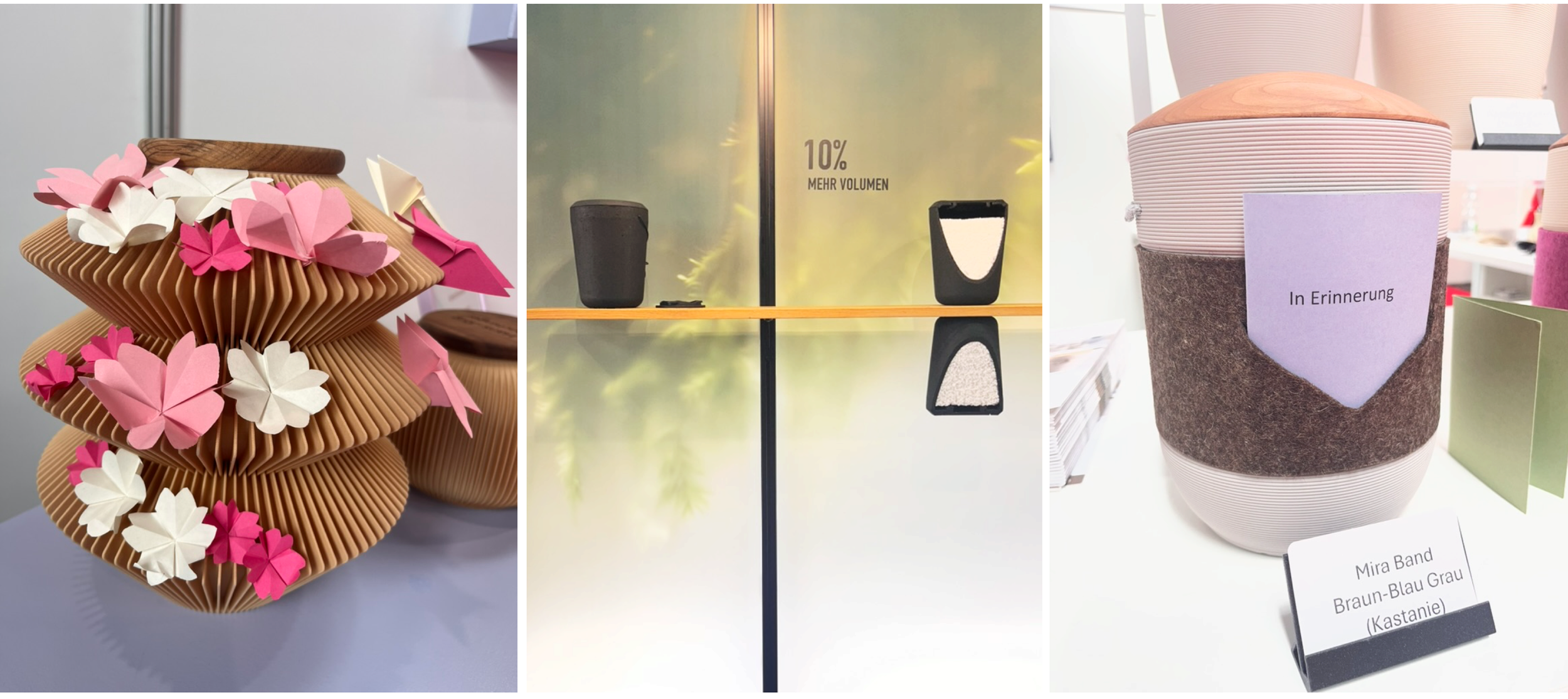
Every year I am surprised again that coffins, especially their overall shape, aren’t changing much (yes, except the mycelium coffin). Urns, by contrast, are where everything seems to be happening, and the range at this year's fair made that clear.
Clay, chalk, mushroom, paper, rice husk, algae, natural fibres, moss, wood. Urns that dissolve in water, urns that grow into trees, urns you paint yourself or personalise with a wishing ribbon. Even an urn in the shape of a handbag. And this year, a milestone: 150 years of cremation in Germany celebrated at the fair itself.
Why are urn designs so versatile? I originally assumed the answer was regulatory: fewer constraints than coffins. The reality is more complicated. Urn regulations in Germany are state-by-state, often vague, and vary by burial type. Coffins have their own material and structural requirements. Neither category is straightforwardly less regulated than the other.
The better explanation lies elsewhere. Designing a new urn is faster and cheaper than developing a new coffin, which means more players, more experimentation, more range. An urn also has a domestic life that a coffin doesn't. It may sit on a shelf for months before burial, which creates a genuine interior design element. The urn carries memory forward into daily life, and that emotional demand is what's driving the innovation.
One detail flagged to me this year that I found very fascinating: cremation ash volumes are slowly increasing. Shorter burning times at crematoria driven by higher energy costs mean more residual matter and we are, as a population, simply getting larger. One supplier has adjusted its volumes accordingly, rethinking materials to accommodate 4 liters of ash without raising prices. It's a small detail that reveals something bigger: even the most intimate products of this industry are shaped by macroeconomic and physiological forces most consumers never think about.
The contrast with coffins remains. Personalisation options exist – colours, prints, photo panels, engraving – but the design language is still largely predictable. Coffins are still waiting for their urn moment.
3. Better together: a new spirit of collaboration
Something has shifted in how some companies in this space relate to each other. Urn manufacturers working with florists. Stationery designers collaborating with urn makers. Decorative manufacturers are draping their products on someone else's. These aren't accidental overlaps, they're deliberate partnerships, built on a shared realisation that no single product can carry the full weight of a farewell experience.
Part of what's driving this is a new kind of ownership over presentation. One urn manufacturer told me she puts enormous effort into designing her product and she's not willing to leave how it's presented entirely to the funeral home or the ceremony organiser. She arrives with suggestions: how to complement the urn with a specific floral arrangement, how to place it on a stand, what the full scene could look like. It reminded me of the IKEA showroom principle: not just selling the object, but showing it in context, making the whole picture imaginable. The product arrives with a vision attached.
The drivers are straightforward: consumers now expect coherent, curated experiences rather than isolated products, and the funeral space is increasingly influenced by interior and lifestyle design sensibilities where a "total look" has long been standard. The market is growing in volume thanks to an ageing population, but competition is shifting from price to quality and differentiation. In that context, collaboration isn't just collegial, it's strategic.
4. Pet urns: from niche to standard
Pet urns are no longer a speciality offering at BEFA; they are now a standard category. Several manufacturers presented their pet ranges prominently on their stands. People were also walking around the fair with dogs in strollers (or on a lead), which felt entirely appropriate yet also quietly revealing.
Why is this happening now? Several forces are coming together here: declining birth rates and smaller household sizes in Germany and across Western Europe mean pets increasingly occupy a role in family structure that previous generations reserved for children. Longer pet lifespans due to improved veterinary care and the growing normalisation of pet grief open up a category that was, until recently, almost entirely overlooked. And there is a consumer base that has already been trained by the human memorial market to expect design quality, personalisation, and emotional resonance from remembrance products.
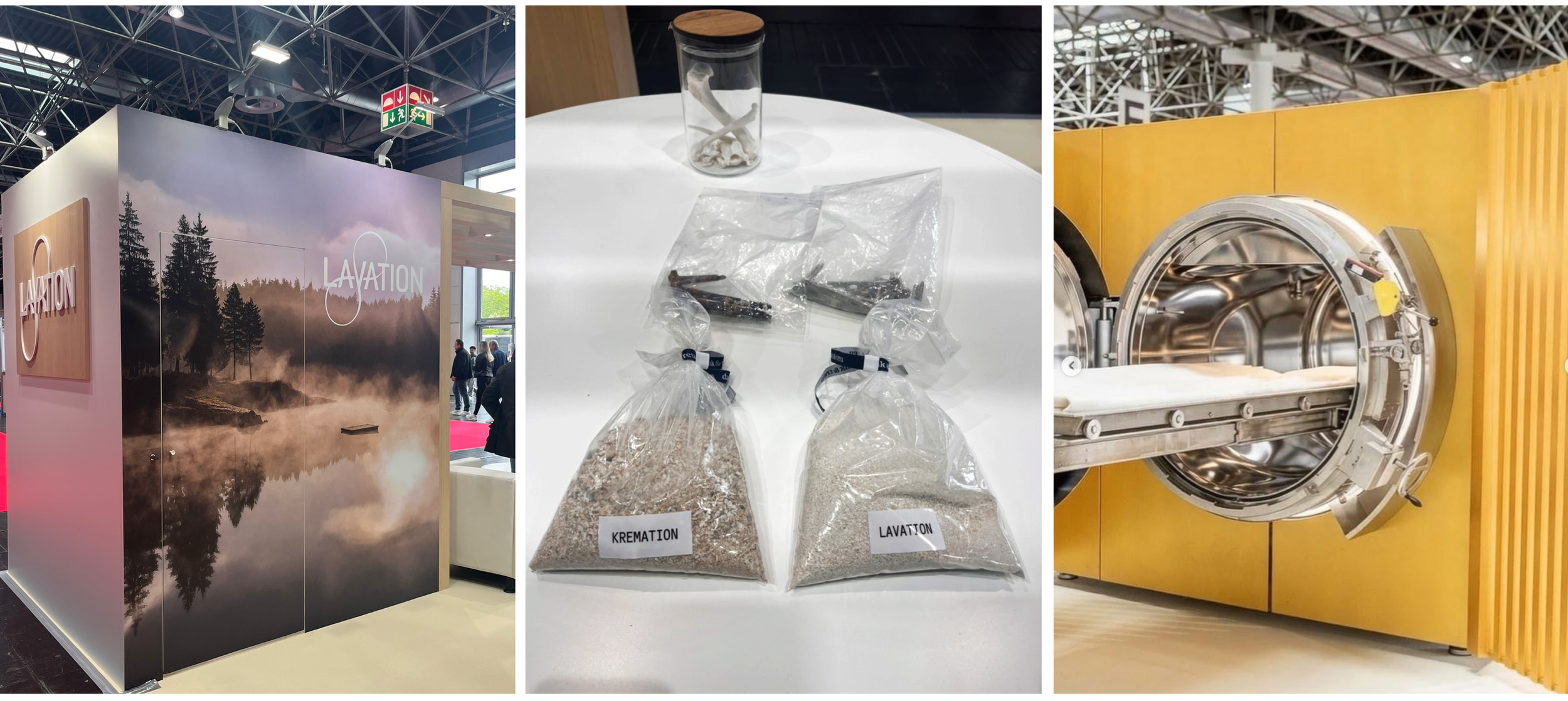
The Lavation picture on the very right is from Trauerbegleitung Bosbach
5. Lavation: Returning to water
I've been aware of this technology (alkaline hydrolysis) for a while but seeing it in person at the fair and getting it explained made it land differently.
The process: The body is placed in a pressure chamber and treated with a warm solution of water and potassium hydroxide at between 90 and 150 degrees Celsius. The alkaline solution gently dissolves organic tissue and body fluids, breaking down DNA, RNA, and pathogens completely in the process. What remains after a few hours is the pure white skeleton, calcium phosphate, which is dried, ground, and handed to the family in an urn, much like cremation ash. The liquid residue is filtered and discharged into the sewage system. No fire. No CO2 emissions. Up to 90% less energy than cremation.
The technology is already legal for animals in Germany under the term aquamation, and is approved in Scotland, parts of the UK, and several US states. Desmond Tutu was buried this way by his own request. In Germany, Krematorium Schwäbisch Hall has developed the process for human use and is awaiting legal approval.
My interest isn't in promoting it, it's in the cultural question it raises. And I think Lavation, the German company behind it, is already asking that question in the right way. Their website calls it Der sanfte Weg (“the gentle way”) and frames it in the language of water, natural cycles, and return rather than technology or efficiency. That is in my opinion the right instinct. The gap between rational approval and emotional readiness is real and wide, and the industry's job now isn't only proving the process works. It's developing the language and ritual framework that makes it feel like a meaningful farewell rather than a chemistry lesson. That's a design and communication challenge as much as a regulatory one. And from what I saw at the fair, people are beginning to take it seriously.
6. Software everywhere – and still not enough
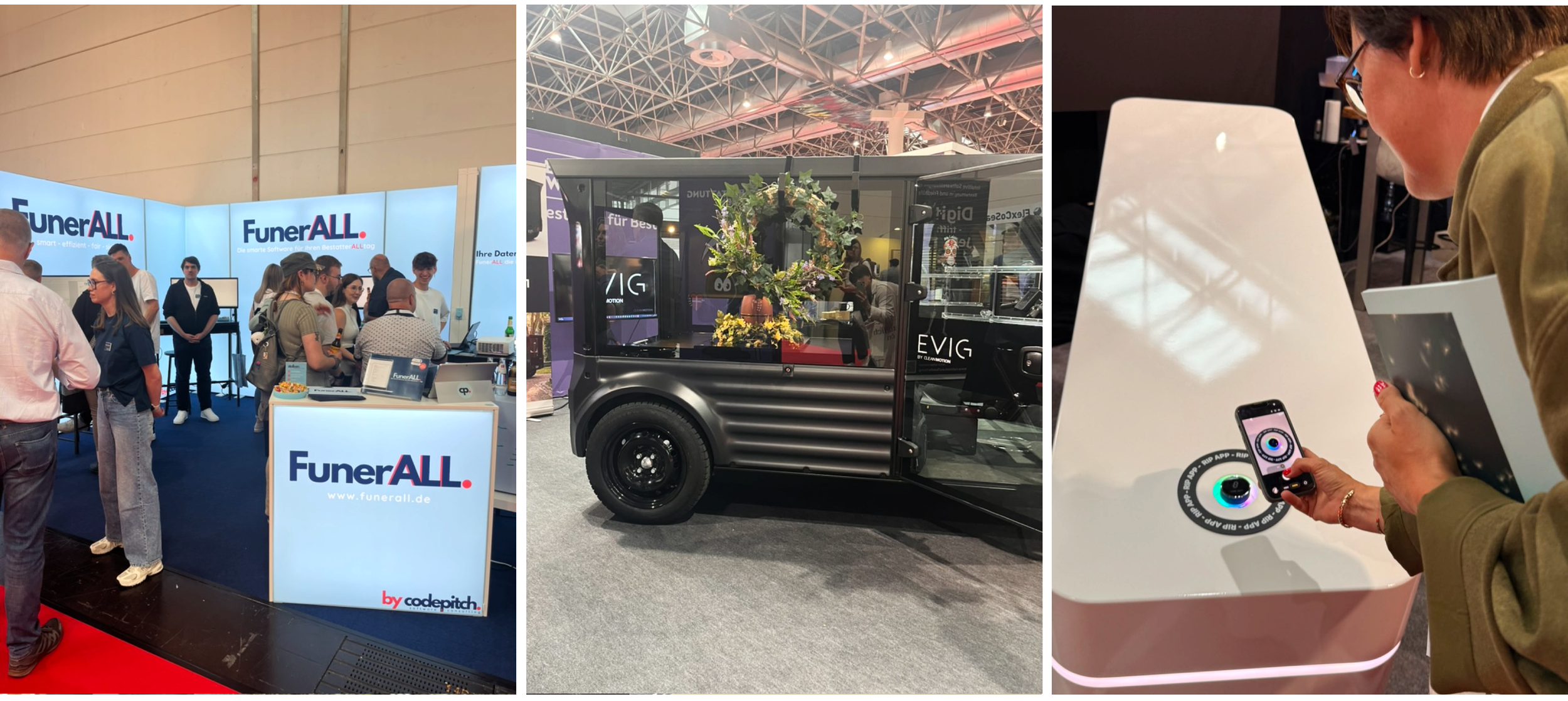
I stopped counting the funeral home software platforms after the first day. New entrants, updated systems, administration tools, case management platforms: the back-office digitisation of the German funeral industry is accelerating, and the range has expanded considerably even since last year.
But the more I walked the floor, the more I felt two tensions that the industry hasn't fully resolved.
The first is the gap between efficiency and human benefit. Streamlined case management frees up funeral directors' time, which in principle means more capacity for the human work that no software can do. But that translation isn't automatic.
The second tension is subtler: how much technology actually belongs in one of the most intimate human experiences there is? Consumers are ambivalent about this (and rightly so). There is something uncomfortable about the idea of too much tech in a space that is fundamentally about presence, slowness, and being with people in pain. The solutions that are convincing are tools that stay quietly in the background, reducing friction for the funeral director without ever becoming visible to the family. The best technology in this space is the kind you don't notice.
The RIP App sits right on that tension. Allowing funeral directors and relatives to track the body's location in real time is a genuinely interesting idea. But whether more information on one of the most distressing days of someone's life brings comfort or adds a layer of surreal distress is a question I can't answer definitively. It probably depends entirely on the individual person.
I believe that efficiency and smooth processes alone shouldn’t be the focus. The question is how we can make bereaved people feel less alone without making them feel managed.
7. Grief support: from afterthought to core offering
Something has shifted in what this industry understands its job to actually be. Grief support apps and groups, grief books, memory jewellery and objects – these were quite prominent and not tucked away in corners. The underlying message: the funeral director's role doesn't end when the ceremony does.
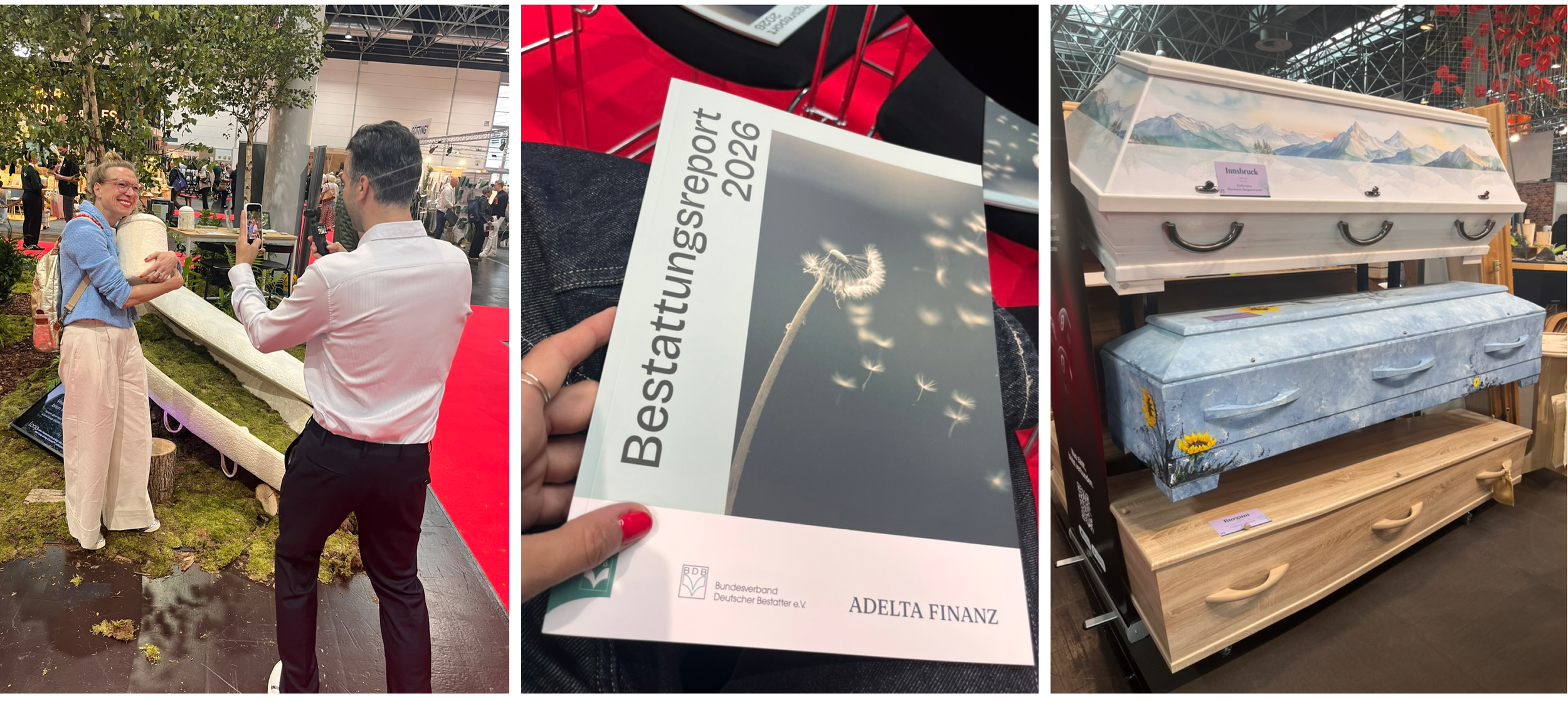
The BDB and Adelta Finanz Funeral Industry Report backs this up, flagging grief counselling and grief apps as areas of growing demand, with loneliness and pastoral care being identified as particularly urgent needs.
There is a growing awareness on both sides: The industry is more and more aware that the products and services it offers are part of the grieving process from the very first moment a family walks through the door, not just logistical tools, but emotional ones. And consumer expectations are rising to match: people are increasingly vocal about feeling abandoned once the formal structure of a funeral ends. The flowers have been delivered, the guests have gone home, and then there is nothing.
I don't know yet how much of what I saw at the fair will translate into genuine structural change, and how much will remain beautifully packaged product. But the awareness is there in a way it wasn't a few years ago.
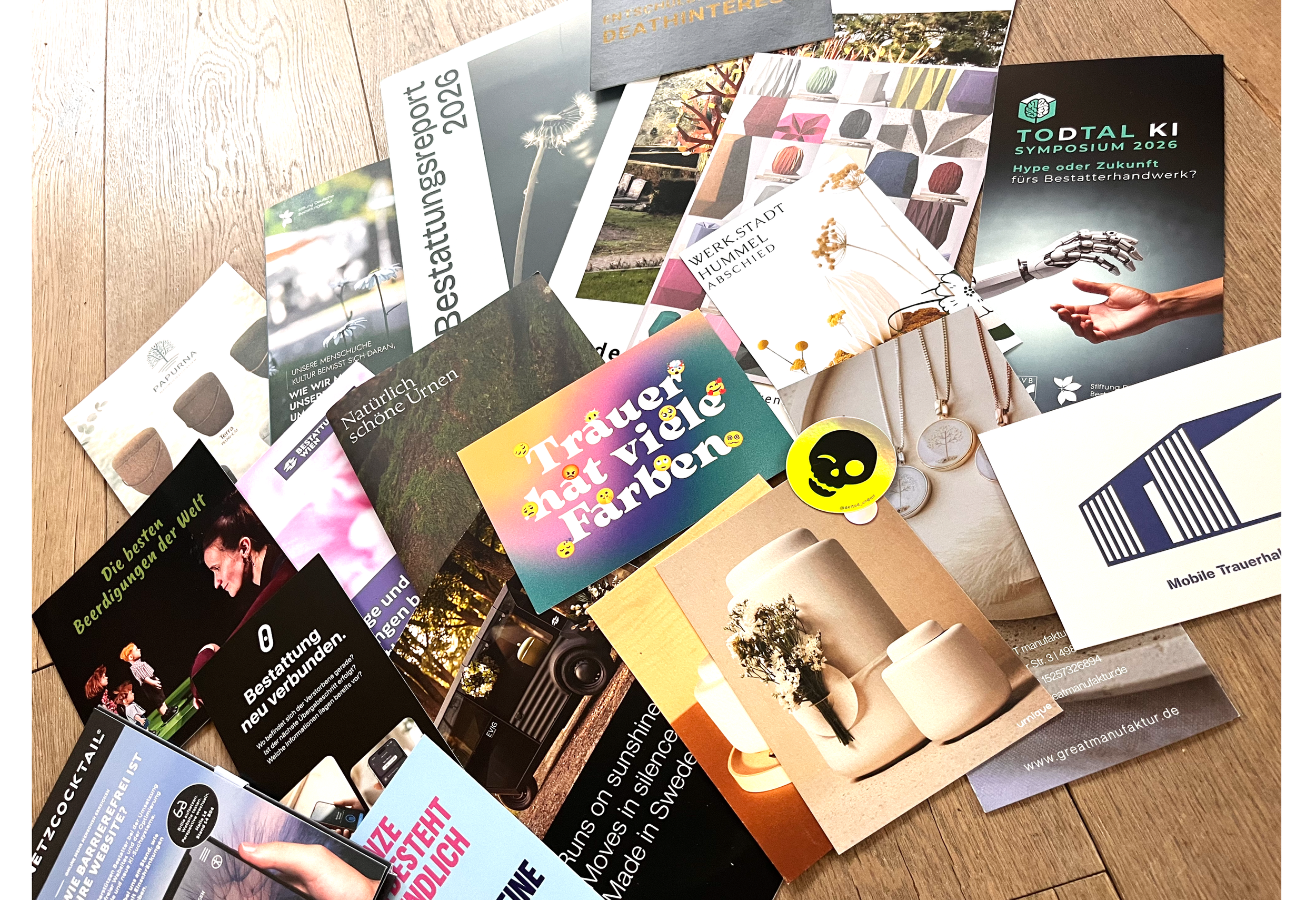
**Personal Takeaway
People sometimes ask me whether trade fairs still matter, whether you couldn't just find all of this online, faster and in more detail, without the travel and the tired feet. And honestly, you probably could find most of the products. But that's not why I come.
What I come for is the gathering itself. The specific moment in time when people who work on the same things from completely different angles find themselves in the same room. The random conversation that reframes something you thought you already understood. The story behind the product that you'd never read in a catalogue. The question from someone you've just met that stays with you.
This year I co-hosted a Startup Dinner again the evening before the fair, bringing together fresh ideas and people who wouldn't otherwise have ended up in the same room. That remains one of my favourite moments of the whole event. Watching connections form in real time.
Four BEFAs in, and I realise this community has quietly become something like my death family: the people I keep running into at different fairs or on projects. Watching the industry change together, from the inside, is a privilege I don't take for granted.
The pace of change within this industry might be slower than in others, but the distance is closing, and I feel it every year a little more. I’m already looking forward to next year!
What do you think?
> If you were at BEFA this year, what did you take away? What surprised you, what disappointed you, what are you still thinking about? I'd love to hear your impressions. Hit reply or find me on Instagram. 🖤
> If you'd like to get deeper insights of any of this, a full trend download, a talk for your team, or just a conversation, please get in touch with me!
Thanks for reading!
> Thanks for reading GOOD GRIEF NEWS, a monthly newsletter on trends and fresh perspectives around death, grief and remembrance. You can see more of my work at goodgrief.me or stefanieschillmoeller.com and feel free to follow me on Instagram.
09.06.2026