
NO BODY TO BURY – HOW CULTURE RESPONDS TO ABSENCE
Ezra Acayan / Getty Images via NBC News
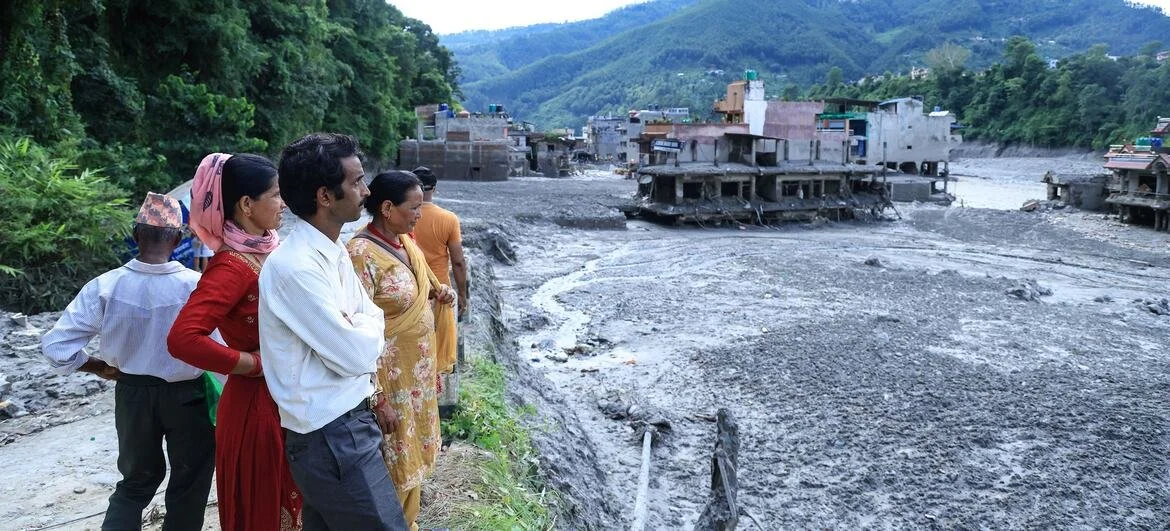
Last week I found myself in a rabbit hole that I hadn't planned for: Videos from the Nepal and Tibet floods that got shared on social media and kept me awake until late at night.
It started with one video of the devastating floods, then came another and then another. The same event was being captured from different angles and replayed endlessly. You could see the force of the water and the unbelievable suddenness and speed of the event. The flood carried some victims' bodies 240 kilometres downstream all the way to India. In some of these images, you could see the exact moment when people were there and then suddenly weren't anymore. At some point, I realised that I was watching something that I could no longer process.
It’s an immense tragedy and I also started wondering: What happens when there is nobody (no body) left to bury?
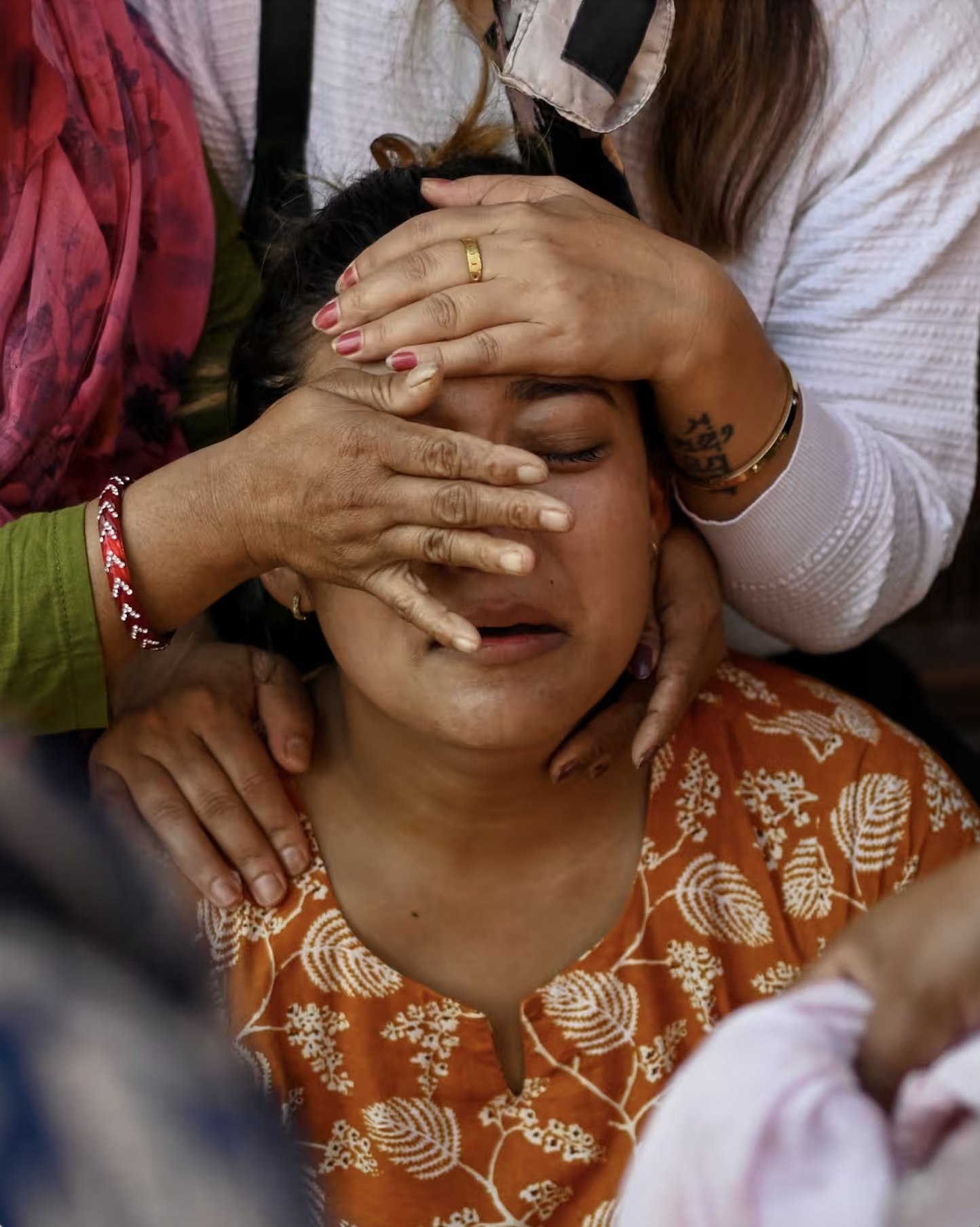
Because this is the reality behind the images. In the aftermath, thousands of people are still missing and in many cases they will never recover the bodies. Even where remains are found, they are often carried far downstream or impossible to identify, forcing the authorities to carry out mass burials that disrupt deeply rooted funeral traditions. And so families are left in a space that is both painfully certain and completely unresolved: they know what happened, but they have nothing to hold on to.
UNICEF/Laxmi Prasad Ngakhusi
The problem with absence
In many ways, modern grief is still built around the presence of the body. It anchors the funeral, structures the ritual and creates a place where loss can become tangible. The body allows us to say: this is real, this has happened, this is where we begin to say goodbye.
But disasters like floods, landslides, plane crashes, or fires disrupt exactly this sequence. They remove the body from the process and leave behind a form of loss that is harder to locate and often harder to accept.
Grief research has a term for this: ‘ambiguous loss’. Psychologist Pauline Boss coined the term in the 1970s, originally to describe the experience of families whose loved ones were declared missing in action during the Vietnam War. Unlike with grief after a known death, ambiguous loss leaves a person stuck between hope and grief because there is no clarity or answer.
Boss has worked with families in the aftermath of 9/11, in Kosovo and in Japan following the 2011 tsunami. The same structural problem emerged everywhere: grief requires something tangible to focus on, and when the body is absent, so is the anchor. Ambiguous loss requires a different kind of relationship with uncertainty.
And what we are seeing in Nepal and Tibet goes even further, because this ambiguity is also shared collectively and played out in public, amplified by images that leave no doubt about what happened.
Ezra Acayan / Getty Images via NBC News
When the body is gone, we create one
The response to this is something that appears again and again across cultures and moments of mass loss: People create substitutes.
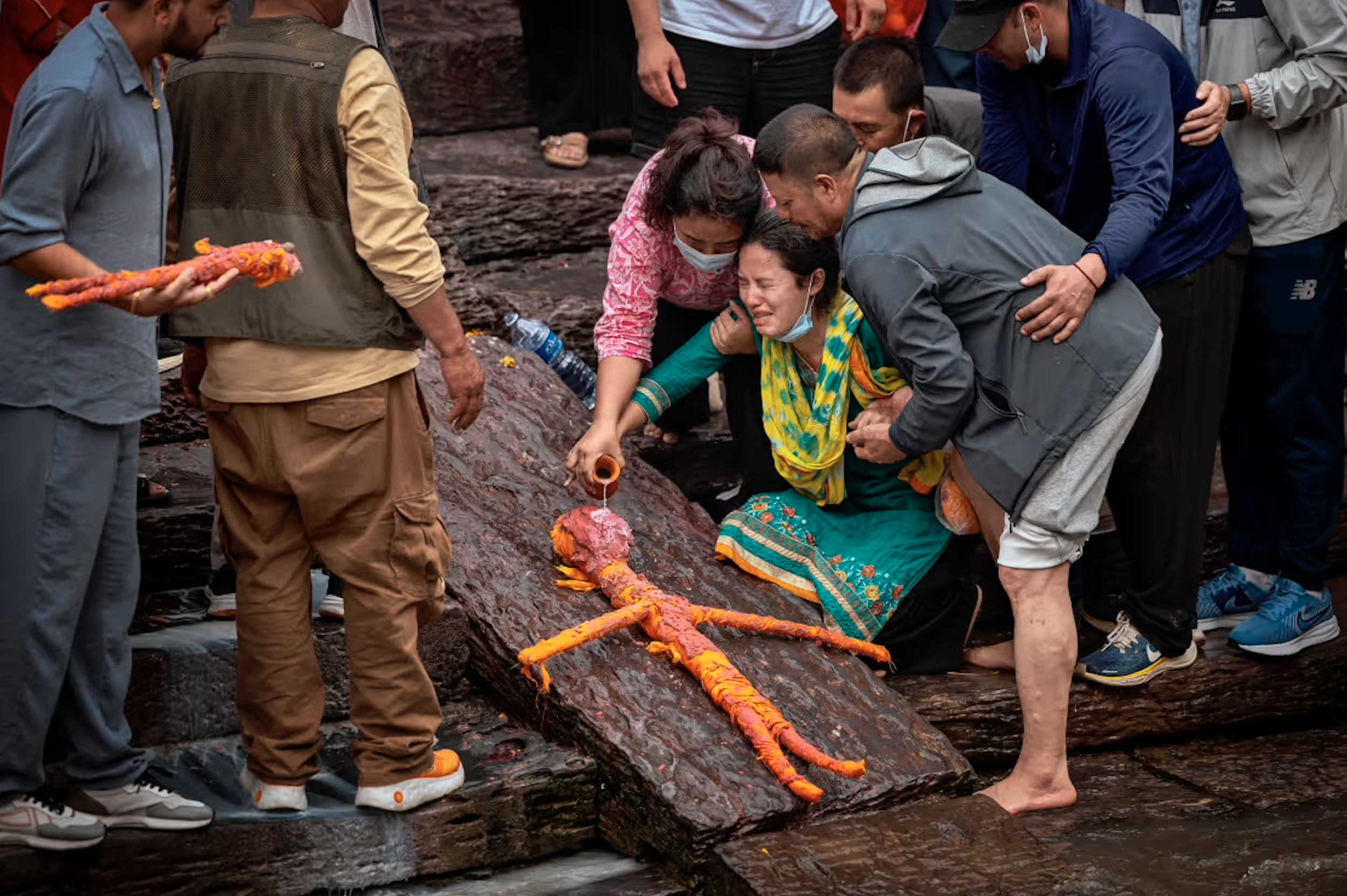
They create symbolic representations of bodies in the form of dolls or effigies that can be burned or buried. They create empty graves, known as cenotaphs, which mark a place even when there is nothing physically present. They transform personal belongings into symbols or gather to perform rituals that spread grief across a community rather than confining it to one person.
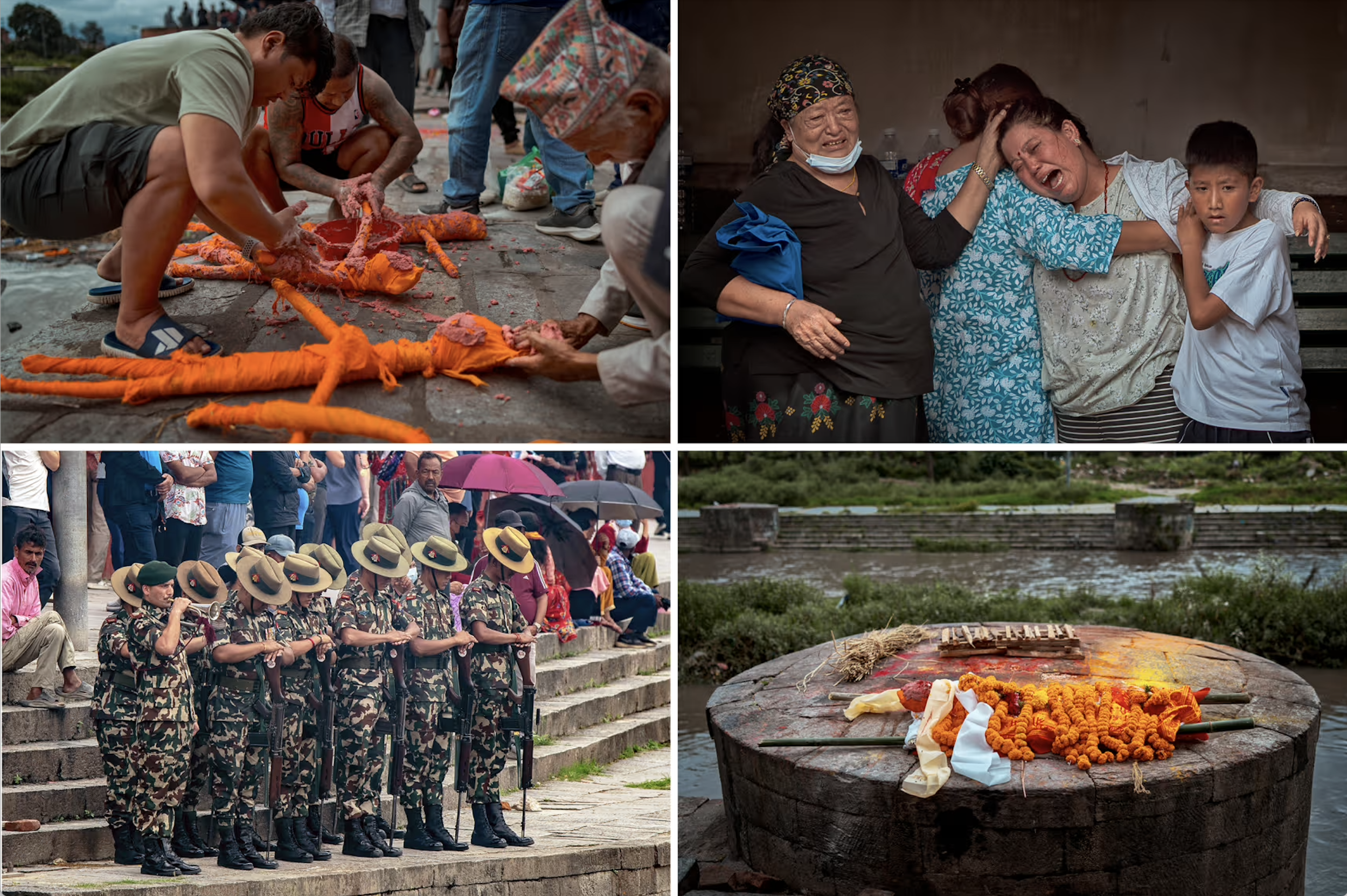
In Kathmandu, relatives of the missing burned effigies made of kusha grass. According to Wikipedia this is “a sacred perennial grass deeply valued in Hindu and Buddhist traditions for its purifying properties and spiritual significance”. The small stick figures got wrapped in orange cloth, were rubbed in paste and covered in garlands of orange flowers. The symbolic funerals were held to “set the soul free”. Nepali service members, dressed in military uniforms and holding rifles, provided military honors as they stood along the steps that lead down from the temple to the river.
In Hindu tradition, cremation is an important final rite, and for some families, performing the ceremony even without the bodies of their loved ones provides a sense of spiritual release. The ritual creates a container for grief that has nowhere else to go.
The role of the elements
There is another layer to this that feels particularly relevant in the context of climate disasters.
When people are lost to water, to fire, to air, or to earth, the rituals that emerge often mirror the force that took them. Effigies are burned when bodies cannot be cremated. Offerings are released into rivers when the dead have been carried away by currents. Prayer flags, smoke, or sound can also align grief with the element that caused the loss, creating a sense of continuity rather than rupture.
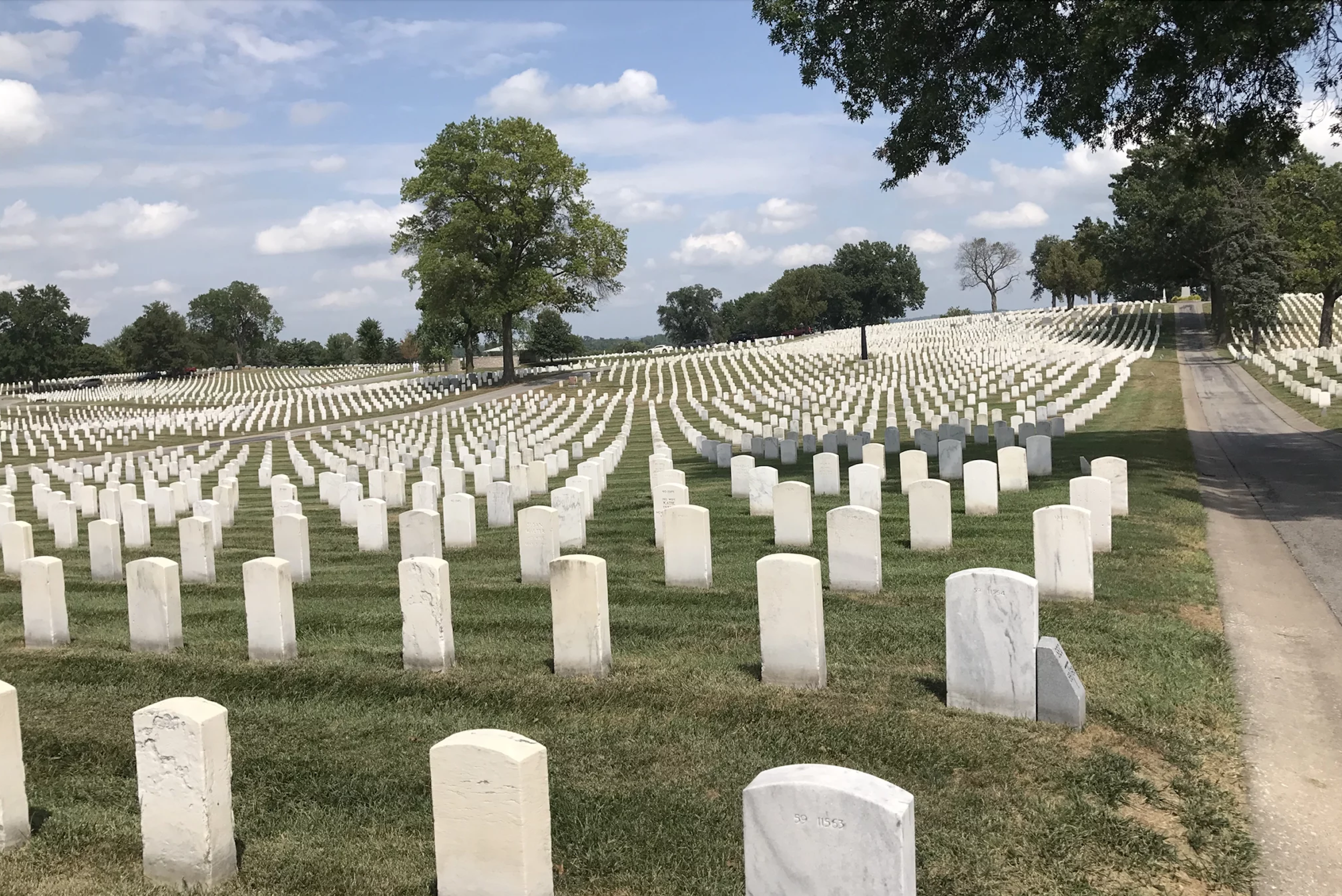
Image of Memorial Day Tribute by the National Veterans Foundation
What cultures have built to hold this
Humanity has been here before and different traditions have developed remarkably thoughtful ways of holding this kind of grief.
The Hindu kush grass effigy (what I saw from Nepal) is one of the oldest and most direct responses: create a surrogate body from natural material, perform the rites upon it, and release it. The body is symbolic, but the ritual is real – and the grief is real.
Buddhist traditions in Southeast Asia offer a parallel instinct. After the 2004 tsunami, relatives of missing people resurrected the practice of holding funerals without bodies with the blessing of the monastic community, a ritual that had been largely forgotten until it was suddenly needed again. The recovery of a forgotten practice is itself a kind of proof: communities have faced this before.
The cenotaph, an empty tomb, a monument with no body beneath it, exists in nearly every major culture throughout history, from ancient Greece to the Tomb of the Unknown Soldier. It shows the relevance of having a place. A place to stand on an anniversary, a place to say: I'm here.
Perhaps the most comprehensive framework is that of Japanese ancestor worship. In Japan, a person's spirit is considered to belong to the same family and community before and after death. According to this framework, relationships are more important than bodies, and continue regardless of whether the remains are ever found.
Ritesh Shukla / Getty Images via NBC News
Why this matters
Rituals are not just expressions of grief, they allow grief to take shape. They create a transition between before and after, between presence and absence. Without them, loss can remain suspended, unresolved, even when the facts are undeniable.
What the situation in Nepal and Tibet shows is that people do not accept this absence as it is. They find ways to give it form, to create something that can carry the weight of what has happened, even if that something is made of grass.
Rituals are not fixed traditions from the past. They emerge exactly when they are needed most. They ask for time, for presence, for some form of physical or shared act that allows the loss to land.
The question, also to myself, is not how others will deal with the absence of bodies, because they already are. It is whether we, in a world where we can witness catastrophe endlessly but are increasingly removed from its physical reality, are still creating moments where loss becomes tangible, or whether we keep scrolling.
At the same time, we cannot ritualise every loss we witness, we never could. What is new is the scale at which we are exposed to it. And with that comes the tension: we see more than we can hold.
Selective attention to suffering is not a moral failure, it is a human necessity. It is how we protect ourselves from being overwhelmed. We are simply not built to metabolise this constant stream of loss.
So maybe the question is simpler:
Which losses are ours to hold?
And are we giving those ones enough?
Thanks for reading!
> Thanks for reading GOOD GRIEF NEWS, a monthly newsletter on trends and fresh perspectives around death, grief and remembrance. You can see more of my work at goodgrief.me or stefanieschillmoeller.com and feel free to follow me on Instagram.
04.09.2026